
Wellesley Sources for Previous Residents
One Wellesley address can be traced through a series of records with different dates and limits. The current GIS card identifies the modern parcel and owner. The Norfolk land index carries transfers and plans. The Historical Society, library, and Town Clerk preserve town directories, Lists of Residents, maps, assessor lists, annual reports, and local newspapers. A federal census can add a household snapshot through 1950, while probate and obituaries may clarify the end of an owner or household trail. No one source substitutes for the others.
| Source | Years it covers | Where held | What it shows |
|---|---|---|---|
| Norfolk land index and images | 1793-present; address fields generally 2003+ | Norfolk Registry and Norfolk Research | Transfers, parties, plans, legal descriptions, and record placement |
| Wellesley Town Directories | 1883-present | Historical Society and library | Year-specific name and address associations |
| List of Residents | 1902-present | Town Clerk and Historical Society | Adult names, addresses, and registered-voter designation |
| Assessor’s historical list | 1941-1967 | Historical Society | Values, square footage, outbuildings, and garden structures |
| Sanborn, atlas, and Gleason maps | 1897, 1919, 1927, 1935 and related map eras | Library of Congress and Historical Society | Building, lot, street, and map context, not occupants |
| Wellesley Townsman | 1906-2005 digitized; later access through NewsBank | Free Library archive route | Local notices, obituaries, moves, civic and property context |
Record the source date beside each name. An earlier owner, a person in a directory, and a person reported in a newspaper can all be real ties to an address without being the same type of evidence.
Trace Wellesley Owners Through Norfolk Deeds
Start the backward trail at the Wellesley GIS Property Viewer. Capture the situs address, parcel ID, current owner, mailing address, lot size, land-use field, and any legal-description clues on the Property Record Card. Next, use Norfolk Research to search the present owner as grantee and limit the town to Wellesley when appropriate. The deed or plan gives the recording date, book/page or certificate reference, seller, legal description, and often a prior instrument reference.
- Use the current parcel card to identify the target lot and present owner. Preserve the parcel ID and exact situs address.
- Search the owner as grantee in Norfolk Research. Open the recorded-land or registered-land result and capture the document reference.
- Match the legal description or plan reference to the target lot. A seller can own more than one parcel, so the name alone is not enough.
- Search the seller as a prior grantee. Repeat the match through each earlier transfer, adding a date and source citation to the chain.
- When a street search fails, use party names, plan references, and the legal description instead of assuming the earlier record is absent.
Recorded Land uses deed books and pages. Registered Land uses a certificate of title and encumbrances. The grantor is the party transferring an interest, and the grantee is the party receiving it. A chain of title is the sequence of those linked transfers. The legal description is the parcel language that ties the sequence to the same land across changing street labels.
Wellesley Deed Searches Before 2003
Norfolk’s online index and images reach back to 1793, but the Wellesley address field is strongest for applicable documents from 2003 onward. That is a comparison worth keeping clear: an older deed can be available online even though a search by today’s street number does not retrieve it. The current address is a starting clue, not the historic key.
Norfolk’s official search rules offer practical workarounds. Index names last name first. Try a wildcard such as KAT* for variants; omit apostrophes and hyphens; search O’Brien as Obrien and La France as Lafrance. Corporations, towns, and trusts may appear as surname-like entries. Older numbered addresses can be spelled out rather than entered numerically. Plan searching by street, owner, surveyor, plan number/year, or plan book/page can bridge a subdivision or lot split.
Index comparison. Free viewing is available in the public land viewer, while a clean image requires the Registry’s stated annual subscription and per-page charge. Mailed copies add a per-document charge.
Wellesley Previous Residents and House Files
The Wellesley Historical Society’s Research Your Home service adds a locally focused route after the official deed chain. Its holdings include directories, Lists of Residents, street-name material, assessor lists, annual reports, historic-home files, maps, photographs by street, and Clarence A. Bunker real-estate files. The Bunker files cover 1895 to 1955 and can contain deeds, titles, mortgages, blueprints, and maps. They do not replace the Registry’s official copy, but they can connect a legal description to familiar property history.
The Society states that a nonmember historic-home file search is $20 and a general research visit is appointment-based, with a $20 nonmember daily fee. Written research inquiries have a stated two-week response target. These are useful access channels when a needed volume or map is not part of an online search.
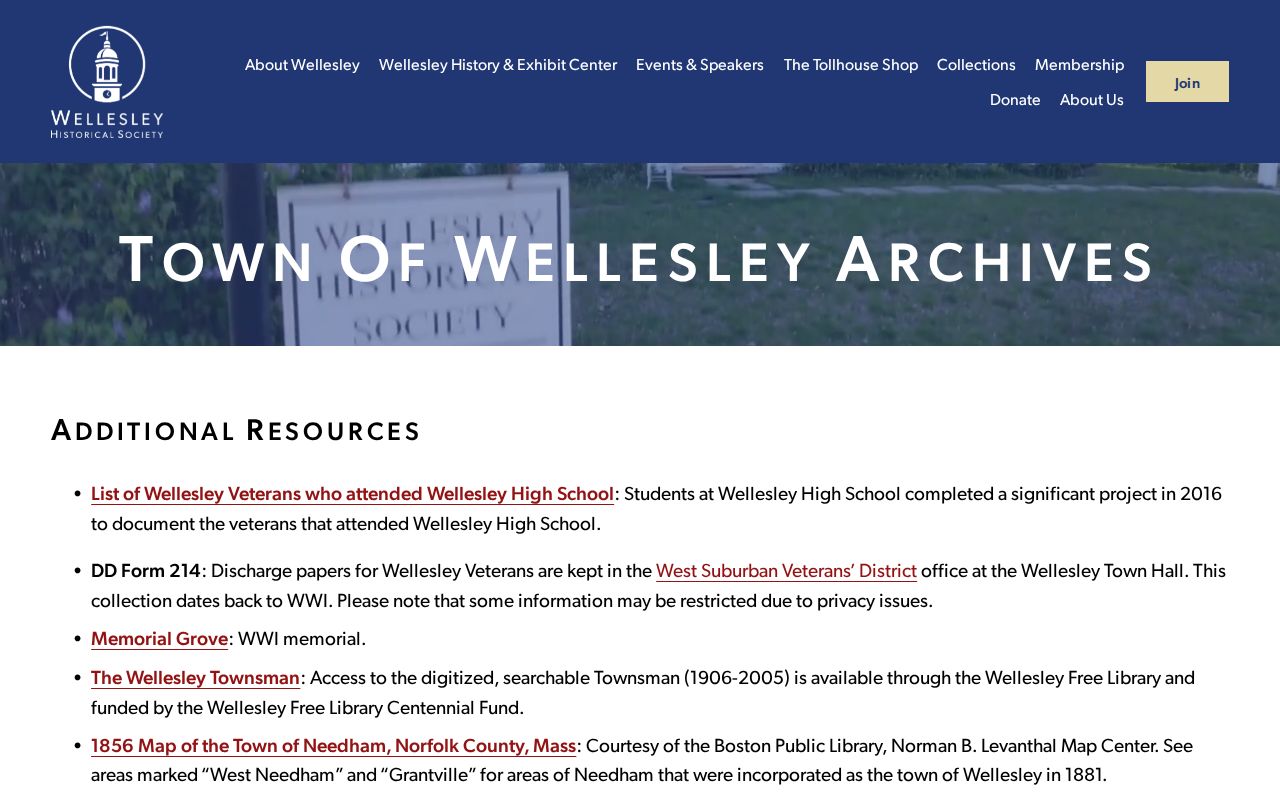
The Wellesley Historical Society town-archives page is the source for the local archive and map routes.
Use a house file to develop map, plan, photo, and document leads, then confirm the recorded ownership sequence through Norfolk land records.
Pair Wellesley Directories With Census Years
The household layer is separate from ownership. Wellesley Town Directories run from 1883 to the present, while the List of Residents begins in 1902. The 1902-1920 List is male alphabetical; the 1921-present series is arranged by street and precinct. A historical directory can show a year-specific association between a name and address, but it is not a legal proof of ownership and may omit people outside the publication’s chosen categories.
- Start with the nearest street-and-precinct List of Residents or directory volume for the address. Record the street spelling and the edition date.
- Check the alphabetical directory in the same or nearby year for surname variants, initials, spouse notation, and cross-references.
- Move in five- or ten-year steps. Mark a first appearance or disappearance as an observation, not as proof of a move or death.
- Pair the result with public federal census years through 1950, deed recording dates, assessor lists, permits, and Townsman notices.
- Inspect the volume’s title page and abbreviation key before relying on a field. The official local finding aids did not verify an edition-by-edition publisher or a complete reverse-directory run.
The directory collections have their own access details on the Wellesley city directory page. For past residents, the key is to lay those dated snapshots over the deed and parcel trail rather than asking one volume to answer every question.
Wellesley Previous Residents and Garden Road
Garden Road exposes a real address-continuity trap. Historical Society material says it is not on the 1897 map but is present on the 1919 map. A pre-1919 search that uses only the modern street name may come up empty even when the parcel or nearby area appears on older material. Wellesley was West Needham or part of Needham before incorporation on April 6, 1881, so earlier deeds, maps, directories, and census entries can use Needham or West Needham instead.
Compare the 1856 Needham map, the 1897 Atlas, 1919 and 1927 Sanborn maps, the 1935 Gleason map, the Society’s Street Name Index, and the deed’s legal description. The Library of Congress 1919 Sanborn collection supplies a free 18-sheet map set. Maps show building and street context, not a list of past residents.
Note: No verified townwide renumbering project or exact renumbering year was located in the official research.
Wellesley Past Residents in News and Probate
The Wellesley Townsman is digitized from 1906 through 2005, with later access through the Free Library’s NewsBank route for library-card users. A newspaper notice can help date a move, civic appearance, property event, death, or obituary mention. It is supporting context, not a certified vital record. The Historical Society also holds family, organization, photo, map, and archival material that can add local context to a carefully dated address trail.
For an estate endpoint, Norfolk Probate and Family Court records and MassCourts may identify a case or docket, subject to protected and impounded-file rules. A probate record can help distinguish an owner’s estate from a similarly named person, but it does not make every household detail public. Retain the case number, court, and document source alongside the property evidence.
Get Wellesley Previous Resident Records
A complete backward trail may require more than an online result. Norfolk Research provides the land index and public image viewer; the Registry also accepts online or mail public-record requests when a copy, record clarification, or custodian response is needed. The Wellesley Historical Society handles research by appointment and written inquiry, and the Free Library maintains the local-history route for directories, maps, yearbooks, and the Townsman archive. The Massachusetts State Library can extend the search through city and town directories, Blue Books, tax valuations, atlases, Sanborn maps, and newspapers.
State and local series have different custodians. The Wellesley Town Clerk keeps local vital, election, annual-census, and town-record material. The Massachusetts Registry of Vital Records and Statistics handles many later statewide holdings, while 1841-1935 genealogy records are associated with the State Archives. Do not assume a historic name or address is searchable online just because its custodian has a website. Keep the office, collection title, date range, and request route with each lead.
Wellesley Previous Residents Research Limits
Past residents are not identical to past owners. A person might appear in a local list, directory, census, newspaper, or probate file without holding title. A deed shows a recorded property interest, not every person who slept at the address. A map establishes a physical setting, not household membership. These distinctions are why a source date and record type should stay attached to every observation.
Massachusetts Address Confidentiality Program protections and M.G.L. c.66 §10B can shield protected home or contact information. Restricted vital records, protected voter information, DMV data, utility accounts, and private delivery data cannot be filled in through a house-history search. For records held by a public custodian, a written request may be made under the Massachusetts Public Records Law, M.G.L. c.66 §10 and c.4 §7 cl.26; the custodian must respond or explain a delay or denial within ten business days.
Lawful use. Use a Wellesley house history for family, property, or archival research. Do not use public fragments to monitor, threaten, intimidate, or harass another person.